Basquiat, billionaires and who owns what?
06-04-2026
I read this headline from Artnews: Record-Breaking $110.5 M. Basquiat painting, now owned by Ken Griffin, to go on view in Miami this summer and, as art often does, it made me think about the bigger picture.
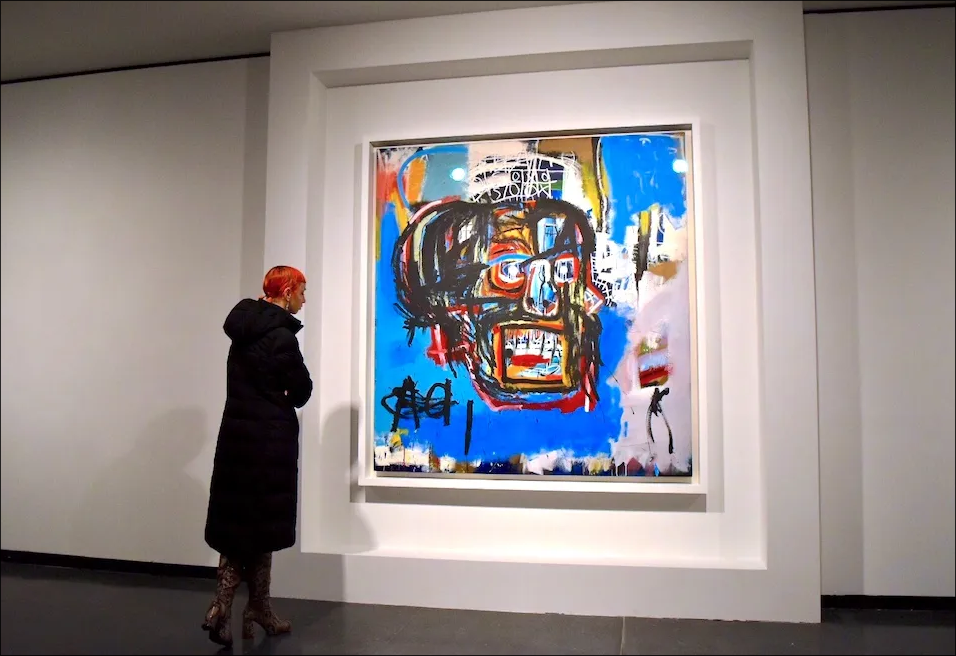
$110.5 million for a skull painting made by a 21-year-old Black artist who was painting about commodification. The irony is not very subtle and it's worth thinking about before we celebrate the "record." This summer, that painting, Jean-Michel Basquiat's Untitled (1982), goes on view at the Pérez Art Museum Miami as part of an exhibition called "Basquiat: Figures, Signs, Symbols." It's being loaned by the man who bought it: Ken Griffin, founder of the hedge fund Citadel. That sentence alone contains quite some contradiction.
The Painting, the price, the problem
Untitled (1982) sold at Sotheby's in May 2017 for $110.5 million, it set two records at once: the highest price ever achieved at auction for an American artist, and the highest price for any work by a Black artist at auction, globally, ever, up to that point. Those numbers got repeated everywhere, but the context behind them got repeated less. By the way, Ken Griffin did not buy it back in 2017, that was Yusaku Maezawa, the Japanese fashion billionaire. However, rumour has it he sold it to Griffin for about $200 million back in 2024.
The painting is a scary looking skull. While painting it, Basquiat was 21, already deep into SAMO© graffiti tags, medical diagrams and the political language of Black artists in America. At that point there was already discussion on how Basquiat's art was being consumed by the exact powers he was critiquing. A skull painting about commodification selling for $110.5 million at a white-glove auction house proves Basquiat's point: the art world has turned his ultimate protest against greed and exploitation into a trophy for the ultra rich.
As for where the record stands now: Basquiat still holds it. Even though the art market moves in waves, (we've seen some ultra-premium auction slowdown as well as new peaks) Basquiat's ceiling hasn't really moved. Fewer works at that tier have simply come to market.
Who is Ken Griffin?
We don't know if Ken Griffin is a real art lover who happens to like Basquiat. What we do know, is that he moved his Citadel hedge fund from Chicago to Miami right before loaning it to a Miami museum. Florida has no state income tax, the regulatory environment is 'friendlier' and Griffin is not the only one who found out about the lovely weather in Florida. Griffin also admitted publicly that the move of his fund was related to seeking a 'better business climate', so we really don't have to read between the lines.
Griffin is also one of the biggest Republican donors in the United States. He has contributed heavily to causes including opposition to progressive taxation, anti-union campaigns and candidates who have specifically targeted diversity programs in public institutions. When the man writing those checks loans a $110.5 million painting to a publicly funded museum in a majority Black and Latino city, the word "philanthropist" is doing a heroic amount of work.
The structure of this arrangement matters: Griffin retains ownership of Untitled (1982). PAMM gets foot traffic, media attention, and a centerpiece for a major show. Griffin gets cultural recognition, favorable press, and probably a tax benefit tied to the appraised loan value. No ownership transferred. When the show ends, the painting goes back to wherever it lives in his portfolio.
So next time you see a major private loan to a public museum, ask one question: is this a gift or a loan? The answer changes everything about what the institution actually got and what the lender kept.
PAMM, Miami, and the geography of this loan
The Pérez Art Museum Miami is situated in an area that is gentrifying pretty agressively, to stay in touch with its Black and Latino roots, the museum runs and participates in numerous cultural programs. In fact, the museum opened in 2013 with a mission to serve South Florida's diverse communities. So Basquiat's own roots are very relevant here. He was Haitian-American and Puerto Rican. When Untitled (1982) goes on the wall at PAMM, it isn't arriving in a neutral space. It's arriving in a city where Black and Caribbean residents have been systematically priced out of neighborhoods their families originally built. And the man loaning the painting relocated his headquarters here as part of the same economic forces accelerating that displacement. It's a rare, tragi-comic mixup: you can look at the art, contemplate the history, and get hit by the capitalism all in one air-conditioned room.
Figures, Signs, Symbols
The exhibition title sounds cool. "Figures, Signs, Symbols" implies a serious analysis of Basquiat's visual language; the SAMO© tags, the crowns, the crossed-out words and the Haitian icons. None of it is decorative, all of it had a specific function. A serious show would need to highlight all of that.
It would also need to highlight who owns the painting, under what arrangement, and what political power the lender brings. A show called "Figures, Signs, Symbols" that doesn't address the irony of those figures and signs now living inside a hedge fund portfolio is doing exactly the thing Basquiat was warning about. (I don't think the curators are unaware of this. I'm curious how much room they were given to address it.)
The loan vs. gift distinction
Most people think a museum owns everything on its walls. Museums rarely clear this up because letting people
believe they own it all makes them look more impressive and powerful.
The press release says "on view" and "presented by." It does not
say "temporarily stored here by a private owner who retains full ownership and will take it back in the
fall."
Here's how private loans actually work: the owner agrees to let the museum display the work for a fixed
term. The owner retains insurance coverage. And depending on how the arrangement is structured, the owner
may claim a charitable deduction based on the fair market value of the loan. Which is the lost, potential
rental income, roughly. The painting appreciates in the meantime. The cultural visibility helps. Additionally, the owner's name goes on
the wall next to one of the most famous paintings in the world.
Wait, what!? I hear you say?
Let me clarify: First, there is the tax deduction. Griffin can argue that by lending the painting for free, he is giving up the "rental income" he could have made if he had leased it to a private gallery or a film set. If the fair market rental value is estimated at 2% of the painting's worth ($110 million), Griffin claims a $2.2 million charitable deduction. This directly lowers his taxable income for the year, saving him hundreds of thousands of dollars in actual cash.
Next, there is the appreciation. While the painting sits in a climate-controlled, high-security museum wing at PAMM, it gains "provenance", a prestigious paper trail of where the painting has been. Being the center of a major exhibition makes the painting more famous and more appraised by experts. Over that year, the painting's market value might jump by 10%. By the time Griffin takes it back, the $110 million asset is now worth $121 million.
Finally, Griffin avoids carrying costs. High-end art requires specialized storage, 24/7 security, and precise humidity control. By putting it in a museum, the public institution (often funded by taxpayers) picks up the bill for the high-end maintenance of Griffin's private property.
In total, after, let's say, a year of lending the artwork to PAMM, Griffin walks away with a painting worth $11 million more than when he started, plus a $2.2 million tax break, all while being hailed as a "philanthropist" on the museum's wall.
This is not illegal, not even unusual, just art business. But worth naming when the painting is Untitled (1982) by Jean-Michel Basquiat, who died broke at 27, and the current owner is one of the wealthiest people in the world.
So, on your next visit, ask your local museum how many works on their walls they actually own themselves. Most will tell you. Some will be surprised you asked.
Closing Thoughts
Basquiat's market position in 2026 is stratospheric, concentrated, and largely inaccessible for me and you. However, Untitled (1982) is something special, the show at PAMM will probably be worth seeing. But none of that resolves the contradiction of a 21-year-old Black artist's record-breaking work, a painting literally about Black death and white capital, living inside a billionaire's portfolio while on loan to a city still fighting over who gets to live in it.
Go see the show and hold two thoughts at once. That's actually what Basquiat was asking you to do...
If this post made you think differently about who owns the art on museum walls, please follow along! I write about art and the art market.